The best model kit store is a local hobby shop that stocks your subject (cars, aircraft, armor, ships, Gunpla or figures), carries the paints and tools to finish it, and confirms what is on the shelf before you drive. Start with a map or directory search for your city, then call the shop. That sequence saves more wasted trips than any other habit in this hobby.
This guide covers what a proper model kit store carries, the ways to find one near you, what to check before you go, and how to judge a shop once you walk in.
TL;DR
- Search by city and by subject ("Gundam kits," "1/35 armor," "model railroad"), because a shop that is great for cars may barely stock aircraft.
- Call or check the shop's own page for hours and stock. Hours often differ by day, and Sundays frequently differ most.
- A real model kit store sells more than boxes: paint, glue, files, tweezers and display cases are the sign of a shop built for builders.
- Event dates for pop-ups and build nights change or get canceled, so confirm with the host before you travel.
- Fanboys lists community-submitted shops and events, and you can add a shop we are missing.
Table of Contents
- What a good model kit store actually carries
- How to find model kit stores near you
- What to check before you drive
- Comparing the types of shop
- How to judge a shop when you walk in
- Buying your first kit at a local shop
- Our perspective
- Find model kit shops on Fanboys
- Frequently asked questions
- Sources
What a good model kit store actually carries
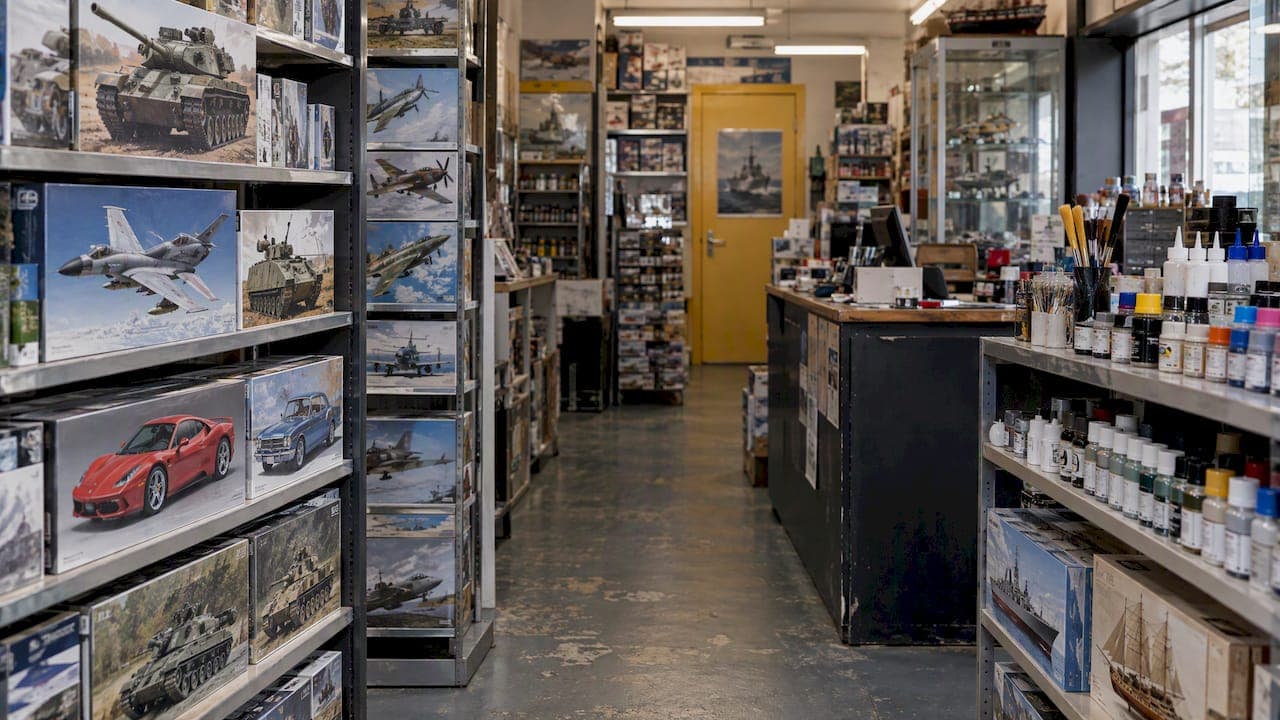
A model kit store is not just a wall of boxes. The kits are the start of a project, and the shop earns its place by helping you finish it.
Large craft retailers show the typical range clearly. Hobby Lobby's model kit category covers vehicle, aircraft, ship, wood and metal kits, along with paints, brushes, airbrush products, glue, thinner, files, tweezers and display cases. A dedicated local shop goes deeper on at least one of those lines.
Depth varies a lot. One independent shop in Marlborough, Massachusetts, says it stocks more than 10,000 plastic, wood, resin and mixed-media models, from snap-together kits to fully rigged ships. Most neighborhood stores are smaller, which is fine, as long as the focus matches what you build.
Subjects you will see on the shelves
Kits generally fall into a few families, and Auto World's buying guide lists the common ones: cars, aircraft, motorcycles, trucks, ships and figures. In practice, you will also find:
- Cars and trucks: street cars, race cars, rat rods and big rigs, often in 1/24 or 1/25.
- Aircraft: WWII fighters, modern jets and airliners, in sizes such as 1/72, 1/48 and 1/32.
- Armor and military: tanks, trucks and figures, often 1/35.
- Ships: plastic warships, sailing ships and wood kits.
- Sci-fi and anime: Gunpla, spaceships, robots and movie vehicles.
- Figures and busts: resin and plastic, usually for more experienced painters.
That last pair is where fandom meets modeling, and it is why a fan directory is a natural place to look for a shop.
Why scale matters before you buy
Scale tells you how many times smaller the model is than the real thing, as the Auto World guide explains. A 1/48 aircraft is 48 times smaller than the original. A bigger number after the slash means a smaller model.
Two practical consequences:
- Kits in different scales will not sit together nicely on a shelf. If you collect aircraft, pick one scale and stay with it.
- Smaller scales mean smaller parts. A beginner who wants a relaxed first build is usually happier with a larger, simpler kit than a tiny, detailed one.
A good shop clerk will ask which scale you collect before they recommend anything. If nobody asks, take note.
How to find model kit stores near you
You have four realistic routes, and the best results come from using two of them together.
Use a store finder or directory
Many retailers and brands publish locators. Horizon Hobby, for example, has a U.S. store finder that accepts a ZIP code or your current location and lets you pick a search radius of 15, 30, 50, 100 or 300 miles. That is a handy model for how to search: start tight, then widen the radius if your area is thin.
Brand locators usually show only shops that carry that brand, and often lean toward remote-control and hobby-grade products. For plastic kits, paints and Gunpla, you want a directory that lists independent shops by what they sell.
That is what we built Fanboys for. You can browse by city and category, and the shops are submitted and corrected by people who actually shop there. If you are in a city we cover, the collectible stores and comic stores pages are good starting points, because many shops that carry kits also carry figures, statues and fan merchandise.

Search a map, then read the shop's own page
Map searches for "hobby shop" or "model kits" work well in dense cities. In a smaller town, widen the radius, then verify. Results ranking for this topic are a mix of single-shop sites, national chain location pages and city roundups that rank "best hobby shops" by review count. Reviews help, but review count favors older shops with a larger crowd, not always the one with the best plastic selection.
Ask where builders already gather
Local modeling clubs, IPMS chapters, Gunpla groups and game store bulletin boards know which shop restocks paint on time and which one never orders anything new. One conversation with a club member is often worth ten search results.
Check the neighbors
Comic shops, game stores and collectible stores often keep a shelf of kits, especially anime and sci-fi ones. They rarely rank for "model kit stores," which makes them easy to miss. In some cities a hobby-focused game store is the closest place to buy Gunpla.
What to check before you drive
A store page and a quick call can save an hour in the car.
Hours, which vary more than you expect
National chains publish store-specific pages with address, phone, email and hours for each location, and those hours differ by store. HobbyTown's own pages show it: the Edmond, Oklahoma store has different Sunday hours than weekdays, and the Alamosa, Colorado store is closed Sunday with separate Monday through Saturday hours. Independent shops are even less predictable. Some close Mondays, some open late on game nights, and some keep reduced hours in winter.
Current inventory
Inventory changes daily. Websites often lag the shelf. When you call, ask for specifics:
- The exact kit name and manufacturer's number, not "a Tiger tank."
- The scale and edition (a re-release can look the same but differ in parts).
- Whether they can hold it for you, and for how long.
- Whether they can special order it, and the typical wait.
Then ask about the supplies you will need. Paint type matters. According to Hobby Lobby, acrylic paint dries faster, while enamel gives a high-gloss finish on car bodies. If you are building a gloss street car, that affects what you buy; if you plan to airbrush, you will want to know whether the shop stocks thinner and airbrush parts.
Events and build nights
Some shops host build nights, paint-and-take sessions, contests and release-day gatherings. Bigger events come from manufacturers. Bandai Hobby's Gundam Base pop-up world tour page says the U.S. stops included New Jersey, Texas and Chicago, and it warns that dates, contents and events may change or be canceled without notice. Treat every event listing that way: confirm with the organizer the week of, and again the day before.

Comparing the types of shop
Not every store that sells kits is built the same. Here is how the main types compare for someone shopping for a first or next kit.
| Type of store | Strengths | Watch out for |
|---|---|---|
| Independent hobby shop | Deep kit range, paint and tools, staff who build | Hours and stock vary; smaller shops may lack your niche |
| National hobby chain location | Predictable layout, published hours, broad basics | Each franchise stocks differently; ask about specific kits |
| Big craft retailer | Convenient, beginner-friendly kits, common supplies | Limited choice for serious or specialty subjects |
| Comic, game or collectible shop | Anime and sci-fi kits, figures, community events | Kit shelf may be small; call first |
| Online marketplace listing | Rare and out-of-print kits | Shipping, condition and fakes to consider |
The right answer is often two shops: a hobby store for paint, glue and tools you need often, and a specialty or collectible shop for the kit you are chasing.
How to judge a shop when you walk in
You can learn a lot in five minutes.
- Look at the paint wall. A wide range and organized racks suggest the owner builds. Empty gaps suggest slow restocking.
- Check the tools. Hobby knives, sprue cutters, sanding sticks, files and tweezers should be there. If they are missing, the shop is mainly a kit seller.
- Ask a real question. "What primer do you use on resin figures?" tells you whether the staff are builders.
- Look for built samples. Finished models on display show that the shop cares about the craft and the community.
- Notice the bulletin board. Club flyers, show announcements and build-night sign-ups are the best sign of a living local scene.
- Ask about preorders. Limited releases, especially anime kits, sell out fast. A shop that takes preorders reliably is worth a loyalty.
Buying your first kit at a local shop
If you are new, a local shop is a better place to start than a website, because someone can steer you away from a frustrating first build.
Tell the clerk what you like, not what you think you should buy. A car lover will do better with a modern snap-together kit than a vintage multi-medium one. A Gundam fan can begin with an entry-grade kit that needs few tools. Auto World's guide notes that kits span many subjects and skill levels, so ask for one at your level.
A starter bundle usually includes:
- A kit with clearly marked skill level and a scale you like
- Sprue cutters and a hobby knife
- Sanding sticks or files
- Cement or glue suited to the plastic
- A few paints and a brush, if the kit is not pre-colored
- A small display case or a shelf spot, so the finished build gets seen
Buy the first kit and the supplies in the same visit. It is cheaper than a second trip and you get advice that fits together.
Our perspective
We built Fanboys on a simple idea: the best local spot for a fan is almost never the one with the biggest ad budget. It is the shop three neighborhoods over that nobody told you about.
Model kit shopping shows this problem clearly. Search results lean on chain pages and ranked roundups, while the shop with the best Gunpla shelf or the only person in town who can talk you through weathering is buried. Our approach is to let the community fix that. People who shop at a store add it, correct its details, and tell others what it is good at. We would rather have a shop listed with a note from a regular than a perfect star rating from strangers.
Our advice: look for the shop that matches your subject, call before you go, and bring a friend to the build night. You will buy better kits and finish more of them.
— Mike
Find model kit shops on Fanboys
Fanboys is a local discovery directory for fans. You can search by city and category, find shops and events near you, and see deals and merchandise from local sellers. Many stores that stock kits also appear under collectibles and comics, so start with the category closest to your hobby, such as collectible stores in San Francisco, or head to the Fanboys homepage to pick your city.

Know a shop we are missing, or a build night worth attending? Add it. Listings from the community are how the directory stays accurate.
Frequently asked questions
Where can I buy model kits near me?
Try independent hobby shops first, then national hobby chain locations, big craft retailers, and comic, game or collectible shops that keep a kit shelf. Use a directory or store finder with your ZIP code, then call to confirm the kit you want is in stock.
Do model kit stores sell paint and tools too?
Most do. Typical ranges include paints, brushes, glue, thinner, files, tweezers and display cases, according to Hobby Lobby's model kit category. Specialty shops usually go deeper on airbrush supplies and finishing products than general retailers.
What scale should a beginner choose?
Pick the subject you love first, then choose a scale that is easy to handle. Scale means how many times smaller the model is than the real object, so a larger number after the slash is a smaller model. Ask the shop for a kit marked for beginners.
Are model kit events and pop-ups reliable?
Treat them as plans, not promises. Bandai Hobby's tour page says dates and contents may change or be canceled without notice. Confirm with the organizer or the shop shortly before you go.
Sources
- Model Kits, Hobby Lobby
- The Spare Time Shop: Models
- Model Kit Buying Guide, Auto World
- Find a Hobby Shop Near You, Horizon Hobby
- HobbyTown Edmond store page
- HobbyTown Alamosa store page
- The Gundam Base Pop-Up World Tour, Bandai Hobby