
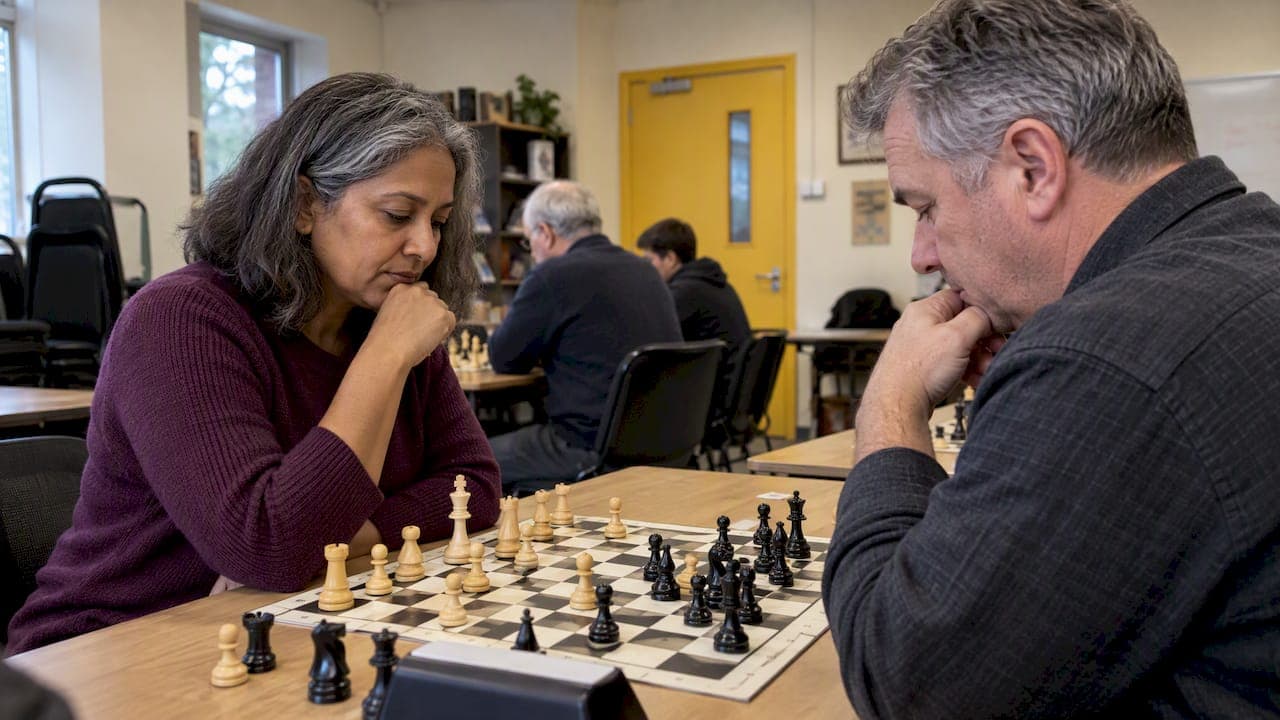
The fastest way to find chess near you is to combine three searches: the national club directory for organized clubs, a map search for libraries, cafés and community centers that host casual play, and a local shop or game store that knows who is playing where. Then confirm the next meeting before you drive. This guide walks through each step, shows what a good club listing looks like, and covers what to expect at a chess shop.
TL;DR
- Start with the US Chess club directory, which the federation says offers free listings of clubs for all regions of the country.
- Fill the gaps with local searches: libraries, coffee shops, colleges and community centers often host the friendliest open play.
- Before you go, confirm the day, time, address, cost and whether beginners are welcome, ideally with the organizer.
- Bring a board, a clock and your US Chess ID if you plan to enter a tournament, unless the announcement says equipment is supplied.
- Local game and collectible stores are useful scouts: they hear about game nights, clubs and events before most directories do.
Table of Contents
- Where chess actually happens in your town
- Step 1: Use the national club directory
- Step 2: Search the places clubs hide
- Step 3: Check the details before you drive
- What clubs offer, and whether beginners can join
- Tournaments: what to bring
- Sharpen your game before the first night
- What to expect at a chess shop
- Perspective: why local discovery beats a generic search
- Find your people through nearby shops
- Promo: find local spots on Fanboys
- A simple plan for your first week
- FAQ
- Sources
Where chess actually happens in your town
If you type "chess stores near me" into a search box, you get a mix of shops, clubs and online platforms. It helps to separate what you are looking for, because the places are different.
Dedicated clubs meet on a fixed schedule, often weekly. Some are run by volunteers in a library meeting room, others by nonprofits with a permanent home. Looking at the pages Google surfaces for this topic, the pattern is clear: a Charlottesville club meets weekly on Monday evenings in a church hall, a Cleveland group meets in a coffee shop with free casual play, and a Nashville center lets people attend casual Thursday nights without a charge. Clubs live in all kinds of rooms.
Tournament organizers run rated events, from one-day weekend tournaments to large multi-day opens. These usually require advance registration and a US Chess membership.
Shops sell sets, boards, clocks and books. A few also have walk-in play space or lessons, but many are simply retail.

Hybrid venues, such as game stores, cafés and comic shops, host board game nights where chess is one table among many. They are easy to overlook and often the best place for a casual game with strangers.
Knowing which one you want shapes your search. A beginner who wants a friendly game on a Tuesday night should not start with a rated tournament listing. A rated player who wants a clock-and-notation game should not rely on a café meetup.

Step 1: Use the national club directory
US Chess, the national federation, says it provides free listings of chess clubs for all regions of the United States and points players to its club directory to find places to play. That makes it the best first stop. Search by state, then look at neighboring cities, since clubs often draw members from a 30 to 45 minute radius.
Many state chess associations also keep their own club pages. The results Google ranks for this topic include state-level directories for Massachusetts, Connecticut and Georgia, which group clubs by town and list contact details, meeting places and sometimes upcoming events. If your state has an association, it is worth a look because volunteers there tend to know about small groups the national list misses.
A directory entry is a starting point, not a guarantee. Clubs move, change nights and disband. Treat every listing as a lead until someone confirms it.
Step 2: Search the places clubs hide
Not every group registers with a federation. Plenty of the best weekly games run through a library bulletin board or a coffee shop that donates a corner. Here is where to look:
- Public libraries. Check the events calendar and the community room bookings. Chess clubs are a staple of library programming, and the ones that meet there are almost always free.
- Community and senior centers. These often host adult groups that welcome new players of any strength.
- Colleges and universities. Student clubs sometimes open their meetings to the public. Check the student organization listings.
- Cafés, bars and bookstores. A map search for "chess" plus your neighborhood often turns up a weekly night.
- Game stores and comic shops. Ask at the counter. Staff know which groups meet in the back room and which nights are quiet.
When you search maps, read the most recent reviews and photos, not just the star rating. A listing with activity from last month is a better bet than one with a high score from several years ago.
Step 3: Check the details before you drive
The single most common failed outing is arriving at a closed room. Before you leave the house, confirm these items:
| What to check | Why it matters |
|---|---|
| Day and time | Many clubs shift to a seasonal or holiday schedule |
| Exact address and room | Libraries and churches have several rooms and entrances |
| Cost | Casual play may be free, while rated play often has an entry fee |
| Beginner welcome | Some groups are tournament-focused and quiet |
| Equipment | Whether boards, sets and clocks are supplied |
| Latest activity | A recent post or announcement shows the group is active |
Cost varies a lot. One Cleveland group, for example, describes free casual play alongside a small fee for rated games. Another center in Nashville states that casual play is free on its open nights. Both are examples of the same pattern: casual is cheap or free, competitive costs a little.
If a listing is vague or out of date, message the organizer. A short note works: "I'm new to town and fairly new to tournament chess. Is it okay to drop in on Thursday?" Most organizers reply warmly, because clubs need new players.
What clubs offer, and whether beginners can join
Most clubs are more welcoming than their reputation suggests. Larger centers often sort their programs by experience so you can find the right level. The Charlotte Chess Center, for instance, organizes its events by level, with beginner scrimmages, youth events and adult social meetups listed alongside tournaments. That is a useful model to look for in any city: if a club publishes separate beginner and social sessions, you can walk in without feeling out of your depth.
Typical offerings include:
- Casual open play. Walk in, find an opponent, play as many games as you like.
- Rated tournaments. Scheduled rounds, a time control, and a result that counts toward a rating.
- Lessons and coaching. Group classes or private coaches, often for kids and adults separately.
- Youth programs. After-school clubs and scholastic events.
- Speed and blitz nights. Fast games, often a good social format for experienced players.
If you are rusty or new, start with the casual night. You will learn the club's rhythm, meet regulars, and hear about tournaments worth entering.
Tournaments: what to bring
If you want to play over the board in a rated event, read the tournament announcement carefully. US Chess says its tournament listings are available online and in Chess Life, and that announcements indicate whether boards and sets are supplied. The same page advises that when equipment is not provided, players should bring their own set, board and clock, plus their US Chess ID card.
A practical packing list for a first tournament:
- Your US Chess ID and membership details
- A roll-up board and a standard tournament set, if the announcement does not supply them
- A digital clock you know how to set
- A pen and scoresheets or a notebook
- Water and a snack, since rounds can run long
- Cash or a card for the entry fee, in case the organizer takes payment on site
Arrive early. Registration closes before round one, and you want time to find your table and settle in.
Sharpen your game before the first night
Walking into a club for the first time is easier when you have a few openings you trust. A repertoire trainer can help you drill lines until they feel automatic. An opening practice app lets you build a personal repertoire, review the weak spots in your recent online games and rehearse your lines with interactive repetition. A half hour of practice a few evenings before the meetup beats cramming on the way over.
What to expect at a chess shop
A chess shop sells the gear that makes a club night better. Depending on the store, you might find:
- Tournament-standard sets and boards, from basic vinyl rollups to wooden display sets
- Analog and digital clocks
- Books for every level, from first lessons to advanced theory
- Gifts and display pieces
Some dedicated shops go further. A well-known New York shop describes chess sets, clocks and books from novice to grandmaster level and public retail space with walk-in chess and lessons, so a store can double as a place to play. That combination is rare, though. In most towns, you will buy gear at a specialty retailer, a game store or online, and play somewhere else.
Two tips when shopping in person:
- Call ahead about stock. Quality sets and digital clocks sell out, and small shops may not list inventory online.
- Confirm hours. Even retailers with a clear schedule can close for events, holidays or restocking. A national federation's own shop, for example, lists weekday-only office hours, a reminder that retail hours are not always the evening and weekend hours players expect.
Can't find a dedicated chess store?
Most cities do not have one. The practical alternative is a good local game store. These shops often carry boards, sets and clocks alongside tabletop games, and they usually run game nights where a chess table fits right in. Our city pages list local game stores you can check, including those in Chicago, Boston, Philadelphia, Atlanta, Charlotte, Richmond and Lexington. Call the store, ask whether they stock chess equipment, and ask whether any players gather there.
Perspective: why local discovery beats a generic search
We built Fanboys around a simple idea: the people who live in a place know it best. A national list can tell you a club exists. A neighbor can tell you it moved to the back room, that Wednesday is the friendly night, and that the owner of the game store down the street keeps a spare clock for newcomers.
That is why we lean on community-submitted listings. When fans add the shops, events and meetups they actually use, the directory stays closer to reality than a static list ever could. Chess is a perfect example. Much of the best play happens in libraries, cafés and game stores that never make it into official databases, and the person who knows about them is usually another player.
Our advice is to use every tool together. Check the official club directory, then look at what your local community says. Search by interest and by city, and treat the shops around you as part of the scene. A comic shop with a game night or a game store with a chess table is often where a new player finds a first opponent.
Misty
Find your people through nearby shops
Chess players overlap heavily with other hobby communities: tabletop gamers, comic readers, collectors, anime fans. That overlap works in your favor. A shop that hosts any kind of game night is a pipeline into local clubs.
If you are exploring your city's wider fan scene, these pages may help:
- Comic shops often post flyers for local game nights. Browse comic stores in Los Angeles, Denver or Portland.
- Game stores in Seattle, Phoenix and Las Vegas are good places to ask about open tables and organized play.
- If you also enjoy club culture beyond chess, our guide to anime clubs near you shows how to vet a group and what to expect at a first meeting. The same checklist applies to chess.
Promo: find local spots on Fanboys
Fanboys is a local discovery platform for fans. You can search by city and interest to find comic shops, collectible stores, game stores, conventions and community events, and you can add a store or event you know about so other fans can find it too.
Start with your city and look at the game stores and event listings nearby. If a place you love is missing, add it.

Browse listings and city guides on Fanboys, then tell us about the game night or club you want others to find.
A simple plan for your first week
If you want to go from searching to playing quickly, follow this order:
- Day 1: Search the US Chess club directory for your state and note every club within an hour's drive.
- Day 2: Search maps and your public library calendar for casual chess nights. Add anything you find to your list.
- Day 3: Visit or call a local game store. Ask about game nights, chess equipment and any groups that meet there.
- Day 4: Message two organizers to confirm the next meeting, the cost and whether beginners are welcome.
- Day 5: Buy or borrow a board and clock if the club does not supply them.
- Day 6 or 7: Go. Arrive fifteen minutes early, introduce yourself, and ask for a game.
The first night is the hardest. After that, you have regulars who expect you back.
FAQ
How do I find chess clubs near me?
Start with the US Chess club directory, which the federation says lists clubs for every region of the country for free. Then search a map for chess at libraries, cafés, colleges and community centers, and ask at local game stores. Always confirm the next meeting with the organizer before you go.
Can a beginner join a chess club?
In most cases, yes. Larger centers often separate events by experience level, with beginner scrimmages and social meetups alongside tournaments. If a listing is unclear, send the organizer a short message and ask whether new players are welcome on the night you plan to attend.
Do I need to bring my own chess set?
It depends on the event. US Chess says tournament announcements indicate whether boards and sets are supplied, and that players should bring their own equipment and US Chess ID card when they are not. For a casual night, ask the organizer. Many clubs have spare sets, but a roll-up board and clock are always welcome.
Is there a dedicated chess store in every city?
No. Dedicated chess shops are uncommon outside the largest cities. A local game store is often the practical alternative for boards, sets and clocks, and many also host game nights. Call ahead to ask what they have in stock.
How much does it cost to play?
Casual open play is often free or close to it, and some centers state plainly that their casual nights have no charge. Rated tournaments typically charge an entry fee and may require a US Chess membership. Check the club's page or ask the organizer for current prices.
Sources
- US Chess Over-the-Board Tournament FAQ
- Charlotte Chess Center events
- Chess Forum, About Us
- ChessFlux opening guides