
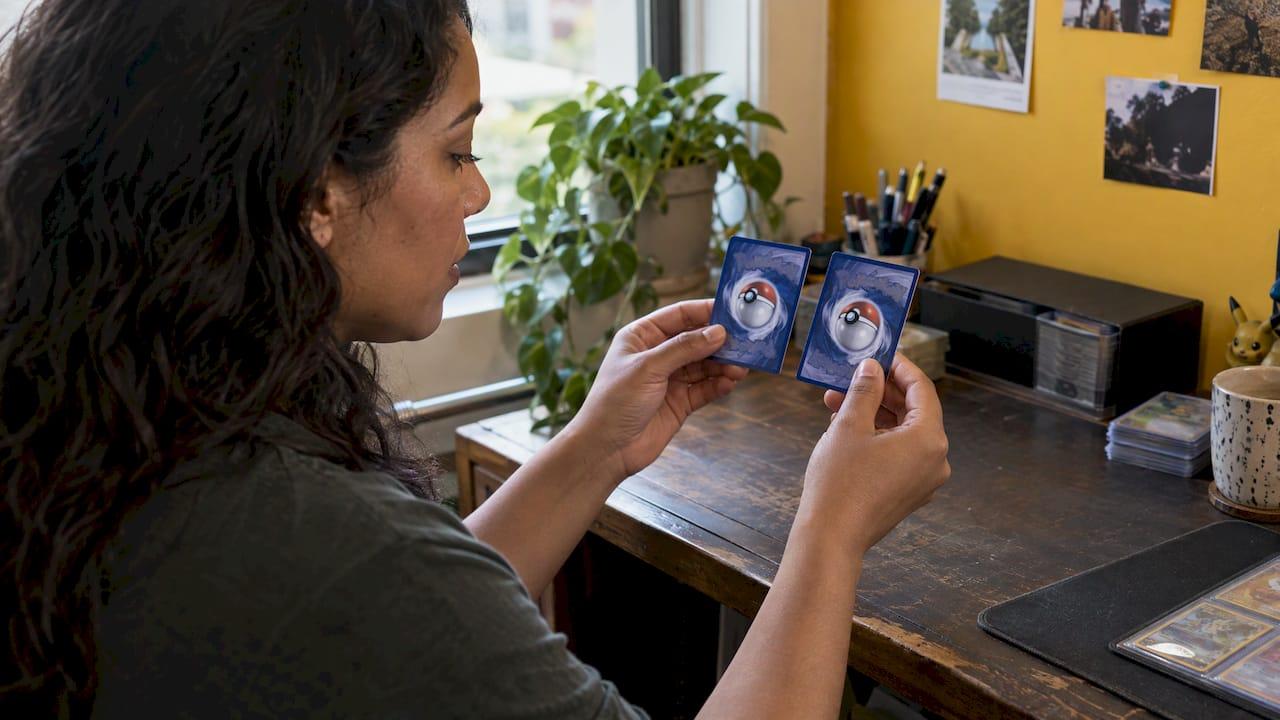
The fastest way to catch a fake Pokémon card is to put it next to a card you know is real and compare the back, the foil, the feel and the printed numbers. No single test settles it. Run several, and if the card is worth real money, take it to a trading-card shop or a professional authentication service. Below is the full routine, in the order we would run it, plus what to do when a card still looks off.
TL;DR
- Start with the back of the card. Hold it next to a card you trust and look for differences in blue tones, color and print sharpness.
- Tilt the card under a lamp and drag a fingernail over the surface. Real modern holos have depth and fine texture, while fakes tend to look flat, glossy or waxy.
- Treat the light test as a first screen only. Newer fakes can pass it, and thick real foils can fail it.
- Look up the exact card (name, set, number, HP, attacks) and compare every detail with a trusted database or a real copy.
- When a card is valuable and you are unsure, ask a local trading-card shop or send it for professional grading. Buy from established shops and verified sellers in the first place.
Table of Contents
- Why fake Pokémon cards are everywhere right now
- Step 1: Compare the back of the card
- Step 2: Read the front like a proofreader
- Step 3: Check the foil and the surface
- Step 4: The light test, used carefully
- Step 5: Weight, thickness and feel
- Quick reference: signs of a fake
- Step 6: Look up the exact card
- Step 7: Check the price and the seller
- Perspective: why local shops are your best authenticator
- Find a trusted shop near you
- What to do if you still can't tell
- Is it worth buying fake Pokémon cards?
- Build your own reference habit
- FAQ
- Sources
Why fake Pokémon cards are everywhere right now
Pokémon cards have turned into a serious collectible market, and where money goes, counterfeiters follow. Graders have documented fakes of everything from vintage promos to brand-new releases. CGC, for instance, has published alerts about counterfeits of a Pokémon Illustrator card and notes that similar counterfeit singles and even uncut sheets have been seen for sale on eBay and Etsy.
Most fakes you will meet in the wild are not museum-grade forgeries. They are cheap bulk lots, "too good to be true" booster packs and single cards of popular chase Pokémon sold at a suspiciously low price. Those are usually easy to catch if you know where to look. The harder ones, the so-called super fakes, need a calmer, multi-step approach.
One point worth settling early: a custom or fan-made card sold openly as a custom card is a different thing from a counterfeit passed off as genuine. This guide is about the second kind. If you ever have a legal question about making or selling cards, talk to an attorney, because we are a local-discovery platform, not a legal resource.
Step 1: Compare the back of the card
The back is the single best place to start, and it costs nothing. Grab a card you know is real, ideally from a pack you opened yourself, and hold the two backs side by side in good light.
What to look for:
- The blue swirl. On a genuine card the area around the Poké Ball has a mix of lighter and darker blues. Fakes often show a flat, uniform blue.
- Color and saturation. Washed-out, dull backs are a warning. So are backs that look unnaturally vivid.
- Bleeding or blurry edges. Where one color meets another, the line on a real card is crisp. Fuzzy transitions suggest a lower-quality printer.
- Logo sharpness. The Pokémon logo at the top and bottom should be clean, with no ink spread.
If you do not have a real card to compare, borrow one from a friend or ask a shop. A ten-second side-by-side check tells you more than ten minutes of staring at one card on its own.
Step 2: Read the front like a proofreader
Next, read every word on the card. Look for spelling mistakes, odd grammar, wrong punctuation and, above all, a missing accent on the "é" in Pokémon. Check that the font and the text color match a real card from the same era.
Then check the energy symbols. On a genuine card they sit neatly in the circle, with room around them. On many counterfeits they are off-center or fill most of the circle.
A caution here: text is not a foolproof test. Many fakes copy the wording of real cards word for word, so a clean read does not prove the card is real. And some very old Pokémon cards had documented printing errors that produced real misspellings. Use the text check to catch lazy fakes, never to clear a card.
Numbers are a stronger signal. HP, attack damage, weakness, resistance and retreat cost should all match the real card. Wildly inflated numbers, such as HP or damage in the thousands, are a red flag, because the game does not print values like that. If you are unsure, look the card up by name, set and collector number and compare each figure.

Step 3: Check the foil and the surface
Holographic and full-art cards are where fakes often give themselves away, because foil is hard and expensive to imitate.
According to Beckett's guide to spotting fakes, a fingernail dragged across a modern holo or full-art card should reveal fine etched grooves and a subtle rasp, while counterfeits usually feel smooth, glossy or waxy. The same guide says that tilting a genuine holo or special illustration rare under a lamp shows a pattern that shifts with depth and a rainbow flowing across the artwork. Fakes tend to show a flat, uniform shimmer, or a holo effect that pixelates at certain angles.
A few practical tips:
- Use a single bright lamp, not overhead room light.
- Tilt slowly in both directions and watch how the pattern moves.
- Compare with a real card of a similar type, since foil patterns vary by era and by set.
- Feel the texture on modern ultra rares. Real texture follows the artwork, rather than sitting as a uniform bumpy layer.
If you want to understand how foil layers and overlays are built, this overview of holographic Pokémon card types explains the different effects, which helps you know what a given card is supposed to look like.
Graders go much deeper than a lamp. CGC's alert on a counterfeit Pokémon Illustrator reports that under ultraviolet and infrared light the holofoil on the fake looked washed out and different in composition compared with the genuine card. That is lab-level work, but it shows why foil is such a reliable tell. In another alert, CGC measured the holo pattern in the art box of a "Disco" holo test print Charizard at roughly 63 pixels wide on genuine cards against 46 on the counterfeit. You cannot do that at your kitchen table, which is exactly why a second opinion matters on expensive cards.
Step 4: The light test, used carefully
The light test is the one everyone has heard of. Pokémon's own support page says counterfeit cards are often easy to see through if you hold them up to a bright light. Real cards are layered, so they block most light, while thin single-layer fakes glow through.
Here is the catch. Beckett's 2026 guide warns that newer super fakes have started adding a dark middle layer of their own, and that thick modern foils like special illustration rares block light naturally anyway. So the test can fool you in both directions. Treat it as a first-pass screen:
- If a card glows brightly through, that is a strong warning sign. Keep checking.
- If a card blocks light, that proves nothing. Keep checking.
Pair it with the edge. Look at the side of the card under magnification or a good phone camera. Real cards show a layered edge, and clean, even cuts. Fuzzy or slightly angled cuts are suspicious.
Step 5: Weight, thickness and feel
Feel is hard to put into words, but it is real. Hold a genuine card, then the questionable one. A fake can feel thinner and flimsy, or oddly stiff, or have a plasticky shine. Some collectors use a precise jeweler's scale, since many online guides describe real cards as clustering around 1.7 to 1.8 grams. We would not rely on weight alone, because holo cards weigh slightly more and sleeves or moisture throw the reading off, but a large gap from a known real card is worth noting.
Always compare against the same kind of card. A basic common, a reverse holo and an ultra rare will not feel identical, even when all are real.
Quick reference: signs of a fake
| Check | What a real card usually shows | What a fake often shows |
|---|---|---|
| Back | Mixed light and dark blues around the Poké Ball, crisp print | Flat blue, dull or oversaturated color, blurry edges |
| Text | Clean spelling, correct accent on Pokémon | Typos, missing accent, though some fakes copy text perfectly |
| Energy symbols | Centered, with space in the circle | Off-center, oversized |
| Numbers | HP and attacks match the real card | Inflated or mismatched values |
| Foil | Pattern shifts with depth, fine texture | Flat shimmer, pixelated, smooth or waxy |
| Light | Mostly blocks light | Glows through, but newer fakes may not |
| Edges | Clean, even cut | Fuzzy or angled cuts |
No row is a verdict. Three or more red flags together is the signal to stop and escalate.
Step 6: Look up the exact card
This is the step that catches clever fakes. Find the card's name, set and collector number, then pull up a trusted reference image or a real copy of the same printing. Match:
- name, set symbol and collector number
- artwork framing and cropping
- attacks, HP, weakness, resistance and retreat cost
- rarity symbol and any holo stamp
- language and version (first edition, unlimited, reverse holo and so on)
Version matters more than people expect. A real card from one printing can look different from another real card with the same name, so make sure you are comparing like with like.
CGC's counterfeit alert on a Simplified Chinese Umbreon Gem Pack Alt Art offers a good example of printing-specific details. The grader notes that genuine Simplified Chinese cards carry a small security stamp in the bottom left-hand corner that was missing on the counterfeit, and that the real holofoil reflects in diagonal bars, while the fake showed fewer.
Step 7: Check the price and the seller
Some of the best protection happens before the card reaches your hands. Beckett's advice is to buy from established shops, verified sellers and official channels, and to be wary of any listing promising sealed products at prices that do not add up.
Practical rules we follow:
- If a sealed booster box is priced far below what every other seller charges, assume there is a reason.
- Be careful with listings that use stock photos only. Ask for photos of the actual card, front and back.
- Favor sellers with a history and a return policy.
- Meet local sellers in public, and inspect the card in good light before paying.
- Pay in a way that gives you buyer protection when you buy online.
Perspective: why local shops are your best authenticator
Every collector we talk to has a story about a card that looked fine in a listing and felt wrong in the hand. That is the core reason we built Fanboys around local spots and people rather than anonymous listings.
A trusted card shop owner handles real cards all day. They know what a genuine holo feels like, they have sealed product from official distributors to compare against, and they will usually give you an honest read in under a minute. Pokémon's own support page points in the same direction: it suggests finding shops in your area that specialize in trading cards and can evaluate potentially counterfeit cards for you.
That is why our directory is community-driven. Fans add the stores and events they actually use, so you find the shop that people in your town trust. Our location-based marketplace works the same way: buying from a local collector you can meet, in a shop or at a meetup, gives you a chance to see the card before money changes hands.
Use the checks in this guide to sharpen your eye, then lean on the people nearby who look at cards every day.
Misty
Find a trusted shop near you
If you want a second pair of eyes on a card, or you would rather buy singles from a shop that stands behind what it sells, Fanboys can point you to one. Browse local listings added by fans in your area, from card shops to game stores and collectible stores.

In Texas, start with our list of Pokémon stores in Austin. Elsewhere, try the collectible stores in Los Angeles, collectible stores in Philadelphia or the game stores in Seattle. You can also start from the Fanboys home page to search by fandom and city, and add a store you trust if it is missing.
What to do if you still can't tell
Sometimes you have run every check and the card is still a coin flip. That is normal. Fakes are designed to survive a home inspection, and no single test proves a card is genuine. Here is the path we suggest.
For low-value cards
Ask a local trading-card shop. Pokémon support specifically recommends looking for shops that specialize in trading cards. Most owners will look at a card while you stand there. Bring the card in a sleeve, and bring the pack or listing details if you have them.

For valuable cards
Beckett says that when a card carries real value and you cannot determine its authenticity, the strongest protection is to send it to a professional authentication service. Grading companies such as PSA, BGS and CGC do this. A common collector rule of thumb is that anything worth around $100 or more deserves professional eyes, but that is a guideline, not an official threshold. Weigh the grading fee against the card's value.
If you bought a fake
- Stop handling the card more than necessary, and keep the packaging.
- Take clear photos of the front, back and edges, and save the listing, receipt and messages.
- Compare it against a verified reference so your complaint is specific.
- Contact the seller and open a dispute through the marketplace or payment provider you used.
- Do not sell it on as genuine. Passing a fake along only moves the problem to someone else.
If you are selling cards yourself and want your listings to earn trust, our guide on how to sell collectibles online covers photos, descriptions and honest condition notes.
Is it worth buying fake Pokémon cards?
People do ask. Some want a cheap stand-in for a card they could never afford, or foil-quality proxies for casual play. We will keep this simple: a fake sold as real is a scam, and it holds no collector value. If you want a card for display or casual play, buy a clearly labeled custom or proxy card from a seller who says exactly what it is, and never try to trade or sell it as an original. Cards you hope to keep or resell should come from verified sources.
The same logic applies to sealed product. A suspiciously cheap box is far more likely to be resealed or counterfeit than a bargain. Shops and local meetups give you a chance to look the product over and ask questions, which no anonymous listing does.
Build your own reference habit
The best defense is a small reference kit and a routine:
- Keep a few cards you pulled yourself from sealed packs as your "known real" comparison set, with a common, a reverse holo and a modern ultra rare.
- Use a bright lamp and a small magnifier or loupe. Fuzzy artwork and tiny print flaws show up fast under magnification.
- Photograph a suspicious card front, back and edge next to a real one, then zoom in on the photos.
- Learn one era at a time. Vintage foil looks very different from modern foil, and mixing them up causes false alarms.
- Join your local game night or meetup. Fans there will happily show you what real cards look like, and swapping tips is part of the hobby. Our game stores in Portland listing is one example of where those nights happen, and other cities have similar pages.
Collecting other card games too? Fakes exist well beyond Pokémon, and the same habits apply. Our guide to Lorcana card shops shows how to find a dependable local shop for a different game.
FAQ
How can you tell a fake Pokémon card?
Compare it with a card you know is real, starting with the back, then check the text, energy symbols, numbers, foil and edges. Use the light test as a first screen only. If three or more details look wrong, treat the card as suspect and get it checked by a trading-card shop.
Is the light test enough to prove a card is real?
No. Genuine cards usually block light and thin fakes glow through, but Beckett notes that newer fakes add a dark middle layer and thick modern foils block light on their own. A card that passes only tells you to keep checking.
Where is the best place to buy Pokémon cards safely?
Buy from established local shops, verified sellers and official channels. Be careful with sealed products priced far below the market. Fanboys lists community-added card shops and game stores by city, so you can find one nearby and ask questions in person.
What should I do if I think I bought a fake?
Save the listing, receipt and photos, then contact the seller and use the marketplace's buyer-protection process. Do not resell the card as genuine. If it might be valuable, take it to a reputable card shop or a professional authentication service.
Sources
- Did I purchase fake or counterfeit cards? (Pokémon Support)
- How to Spot a Fake Pokémon Card (Beckett News)
- Counterfeit Card Alert: Pokémon Illustrator (CGC)
- Counterfeit Card Alert: "Disco" Holo Test Print Charizard (CGC)
- Counterfeit Card Alert: Simplified Chinese Umbreon Gem Pack (CGC)
- Holographic Pokémon Cards: Types, Value and Custom Options