
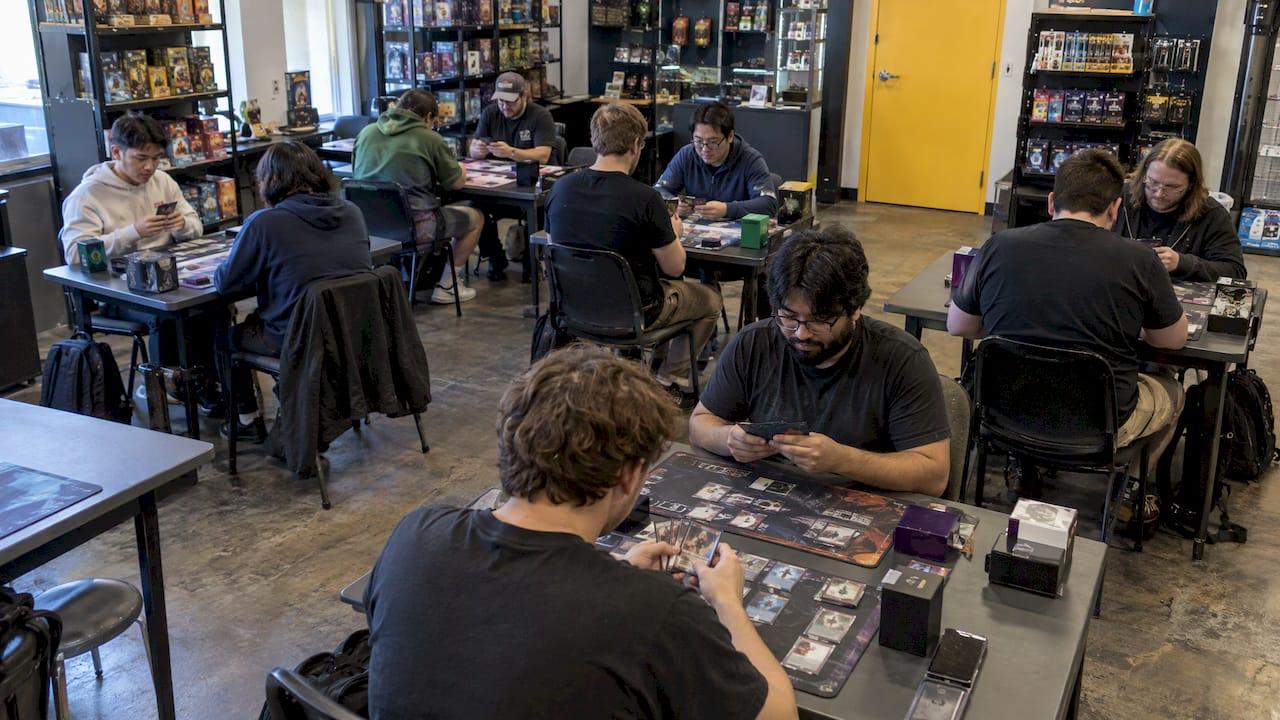
Collectible card game events come in four main kinds: sanctioned tournaments, release-day prereleases, weekly shop nights and big card shows. The fastest way to find the right one is to start from the local shop, because that is where most of them are actually run. Fanboys is built for that search: fans add local stores and events themselves, and you can look by fandom and location instead of scrolling a national list.
Below you will find what each event type is, where to find them, what to check before you drive anywhere, and how to get more out of a card show.
TL;DR
- Tournaments, prereleases and weekly leagues are run by game stores; card shows and conventions are run by promoters and are mostly about buying, selling and trading.
- Each major game has an official store or event locator, and a local directory shows you the shops around them in one place.
- Entry fees vary widely: a few dollars for a weekly league, more for a prerelease, more again for a qualifier. Check the event page for the current price.
- Many events want photo ID, an account in the game's app, and a parent's signature for younger players. Register before you go.
- Anime card games such as One Piece, Digimon, Dragon Ball and Union Arena usually run on set nights at the same shops that host Pokémon and Yu-Gi-Oh!.
Table of Contents
- The four kinds of card game event
- How to find events near you
- What to check before you go
- Card shows: how to hunt for the card you cannot find
- Our perspective
- Find your next event on Fanboys
- FAQ
- Sources
The four kinds of card game event
People search "TCG events" and mean very different things. Sorting them first saves a wasted trip.
Organized play tournaments. These are the publisher-sanctioned events: you register, play rounds against other entrants, and sometimes earn points toward bigger competitions. Pokémon's official local tournament page lists League Challenges, League Cups, Prerelease tournaments and alternative formats such as Gym Leader Challenge. A League Challenge is the entry-level event with a small number of Championship Points. A League Cup is a similar structure that often draws more players and awards more points.
Prereleases. You play with cards from an upcoming set before it reaches shelves. They are the friendliest tournaments for newcomers, because everyone is opening new cards at the same time.
Weekly shop nights. A league night, a casual draft or a learn-to-play evening. These are low-pressure and the best place to meet regulars. Prizes are usually small.
Card shows and conventions. Here the point is the tables: vendors selling singles, sealed product, graded cards and sports cards, with collectors trading in the aisles. Some have tournaments on the side, but you go for the hunt. If sports cards are part of your hobby, our guide to how to find, plan and work a sports card show covers the routine.
The same weekend can hold all four in one city, so read the event description for which one you are looking at.

How to find events near you
Start with the shop, not the calendar
Most recurring events are hosted by a store. That means the question "where are the card game events near me?" is usually "which local shops run them, and on what nights?" Fanboys lists stores and community events by city and by fandom, and because listings come from the people who actually play and shop in each area, small stores that national lists skip tend to show up. Browse the collectible stores in Los Angeles, Philadelphia, Denver or Phoenix, or look at game stores in Seattle, Portland and Mesa.
Then use each game's official locator
Once you know which shops are nearby, the publishers' own tools show their sanctioned schedules:
- Pokémon: the Event Locator on the official local tournaments page finds League Challenges, League Cups, Prereleases and alternative formats.
- Yu-Gi-Oh!: Konami's Official Tournament Stores list for North America can be searched by zip code, city or state, with an adjustable radius. A store that is missing can email us-cardsupport@kde-us.com to ask for its schedule to be added.
- Magic: The Gathering: Wizards of the Coast runs an events hub with a store and event locator for official play. Search it by city or postal code and filter by format and date.
If Yu-Gi-Oh! is your game, our guide to finding the right Yu-Gi-Oh! card shop goes deeper on what to look for in a store.
Anime card games and the shops that run them
Anime card shops tend to be ordinary card shops with a strong Bandai and One Piece crowd. A typical schedule: one shop's events page lists a weekly Pokémon League on Monday at 6 p.m. for $7, with 30-minute best-of-one rounds, a participation booster pack and a Pokémon prize pack for every player. The same shop runs $7 Bandai TCG tournaments (Digimon, Dragon Ball, GUNDAM, Union Arena) and $10 One Piece tournaments on Fridays and Saturdays. That pattern, one weeknight for the big game and weekend nights for the anime games, is common, so when you search for "card shops with tournaments" look for a weekly calendar, not a single date.
What to check before you go
Sanctioned events have rules that vary by game, and a few of them can turn you away at the door. Run through this list the day before.
1. Registration
Many events now register through an app. For Yu-Gi-Oh! Day, registration happens in the NEURON app by scanning a QR code at the store. Union Arena events require a Bandai TCG+ account and pre-registration information or an entry fee. Set up the account at home, not at the counter.
Larger qualifiers are stricter. The Yu-Gi-Oh! World Championship Qualifier requires online pre-registration, a deck list submitted by the deadline, a tournament-legal deck and a photo ID. A late deck list gets you dropped, so do not leave it for the morning.
2. Photo ID and age
Bring ID even if you think the event is casual. The Union Arena rules ask for a school ID, state ID, driver's license or passport at events with an age limit or an invitational structure. Cyberpunk TCG's tournament rules say players under 17 may not take part in Organized Play, and the name on your account, your player ID and your government photo ID must all match.
For younger players, Yu-Gi-Oh! Day requires that duelists under 16 have a parent or guardian sign the registration form. If you are bringing a kid, check the age rules for that specific game and event first.

3. Entry fee and what it includes
Fees range widely, and what you get for them matters more than the number:
| Event type | Typical cost | What the fee usually covers |
|---|---|---|
| Weekly league night | A few dollars to about $10 | Play, often a participation pack |
| Prerelease | Often $30 to $40 | A deck and several booster packs |
| Yu-Gi-Oh! Day (2026) | $13.50 | Three booster packs and entry |
| Qualifier or regional | Set by the organizer | Entry; deck list and ID required |
The Yu-Gi-Oh! Day price comes from the official 2026 FAQ, and it includes three Battles of Legend: Glorious Gallery booster packs. The prerelease range comes from a LAist report on where to play Pokémon in Los Angeles, which also notes that casual shop play often offers only bragging rights, maybe store credit or promo cards. The same report describes a Burbank shop charging $8 for youth Pokémon nights ($5 before 5 p.m.) and lending beginner decks. Prices change from season to season, so treat these as examples of the pattern and read the event page for the current fee.
4. Format and your deck
Know which format the event uses before you build or bring anything. Standard, Advanced, Gym Leader Challenge and sealed prerelease all play differently, and a constructed tournament will want a legal deck under the current banned and limited lists. If you are brand new, a prerelease or a learn-to-play night removes this problem: the product is in the box.
5. Confirm with the organizer
An event listing is a lead. The store sets capacity, late-registration rules and prizes, so a popular night can fill up. A short message or call to the shop the day before takes a minute and saves a drive.
Card shows: how to hunt for the card you cannot find
If you are after hard-to-find cards, a show can beat a store. In 2025, Pokémon was the most-searched collectible on eBay and sealed packs at retail price were scarce; NPR reported that card shows are popping up across America as a place where collectors buy and trade. One customer in that story spent $600 in cash at a show.
A few habits make a show worth the entry fee:
- Go with a list. Write down the exact cards, sets and conditions you want.
- Walk the whole floor first. Prices for the same card can differ table to table.
- Bring small bills. Many tables deal in cash, and it makes haggling easier.
- Set a budget before you enter. A card show buying strategy built around knowing market values before you spend helps you leave happy instead of regretful.
- Bring cards to trade. Vendors and collectors often trade, and your duplicates are currency.
Anime collectors have their own version: conventions with dealer rooms and card tournaments side by side. Look for those on your city page, since they come around on a yearly cycle and organizers post the current dates.
Our perspective
Every fandom starts with a local place. For most players that is a table at a game shop, a Friday night with strangers who become friends, a binder flipped open at a show. National calendars are good at listing the big events and weak at the small, recurring ones where people actually get hooked on the hobby.
That is why Fanboys is built on community-submitted listings. The player who knows the shop that runs a quiet Digimon night, or the collector who found a new monthly show, can add it, so the directory reflects what is happening on your block. Search by fandom and location, and an anime card night is as easy to find as a comic shop.
Our advice is simple: pick a shop near you, show up to a low-stakes night, and build outward from there. Sanctioned tournaments, prereleases and shows all get easier once you know people.
Misty
Find your next event on Fanboys
Fanboys is a local discovery platform for fans: comic shops, collectible stores, gaming events, conventions and meetups, with city guides and listings added by the community. Pick your city, find the stores near you, and see what is on. You can start with collectible stores in your city or go to the Fanboys homepage to search by fandom and location.

If you run a shop or organize a show, you can add it so local players can find you.
FAQ
What is the difference between a TCG tournament and a card show?
A tournament is organized play: you register, follow format rules and play rounds. A card show is a marketplace where vendors sell and collectors trade, and any tournament is a side attraction. Use tournaments to play and shows to buy.
Are card game events suitable for beginners?
Yes, particularly prereleases, learn-to-play nights and weekly leagues, where many players are new. Some shops lend beginner decks. Check the age rules for the specific game, since some official events set minimum ages or require a parent's signature for younger players.
How do I find anime card shops with tournaments?
Look for shops that list a weekly calendar with One Piece, Digimon, Dragon Ball or Union Arena nights. On Fanboys you can search by fandom and city to see which nearby stores cater to anime card games, then check the shop's schedule before you go.
What should I bring to a trading card game tournament?
Bring photo ID, your game account or player ID if the event uses one, a legal deck for the format (or nothing, for sealed events where product is included), and the entry fee. Register ahead if the event uses an app or online form.
Sources
- Local Pokémon TCG Tournaments
- Official Tournament Stores, North America, Yu-Gi-Oh!
- Yu-Gi-Oh! Day FAQ, North America
- Yu-Gi-Oh! World Championship Qualifier 2026 FAQ
- Union Arena TCG Tournament Rules Manual
- Cyberpunk TCG Official Tournament Rules
- Where to play Pokémon TCG, LAist
- Hunting for Pokémon cards? Try a card show, NPR
- Events, Moxie Card Shop
- Card Show Buying Strategy