
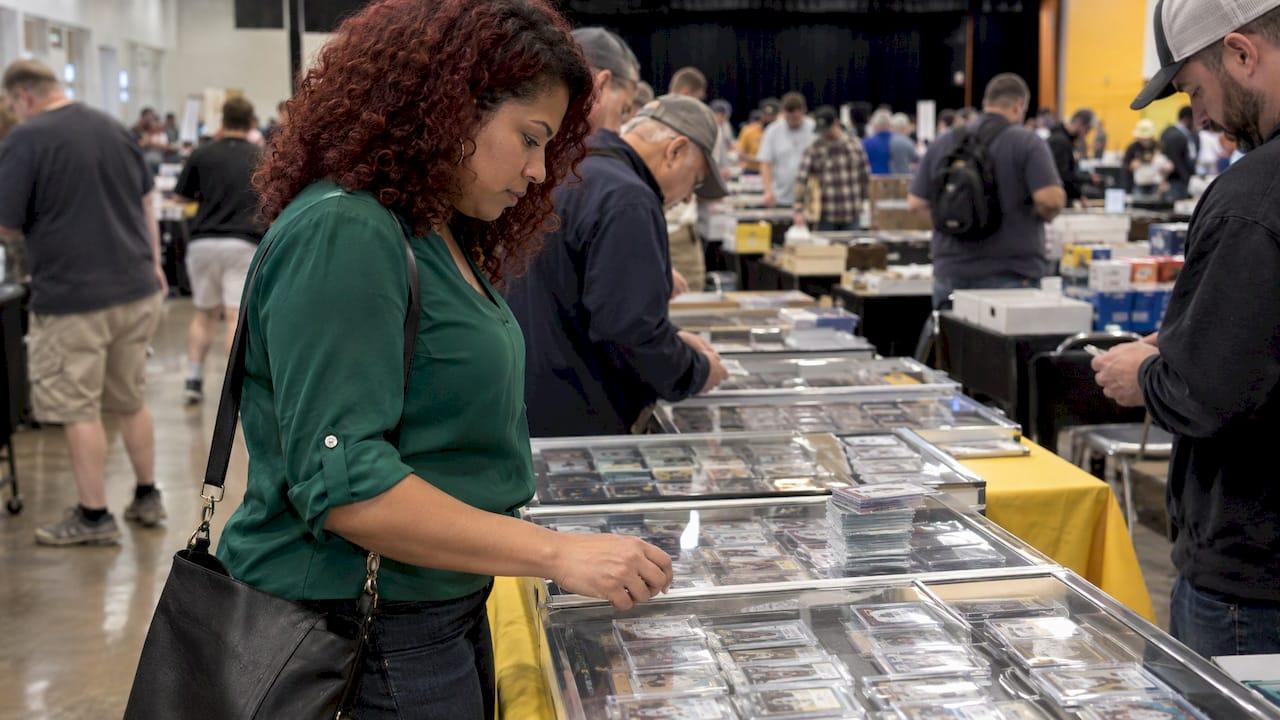
A sports card show is a one-day or weekend event where dealers and collectors set up tables to buy, sell and trade cards and memorabilia. To find one, search your city and state plus "card show", check local hobby shops and community listings for flyers, and look for recurring monthly shows at hotels, expo centers and VFW halls. Admission is usually cheap, often $10 to $20 in 2026 listings, and the best results go to people who arrive with a plan.
This guide covers what you will see, what to check before you go, how to buy, sell and trade without getting burned, and how to start a baseball card collection on a budget.
TL;DR
- Card shows range from small hotel-ballroom events to huge conventions with 600 or more dealers. Check the organizer's page for hours, admission and parking before you drive.
- Bring cash plus a backup payment method, sleeves, toploaders, a want list with recent sold prices, and a charged phone.
- Walk one full lap before you buy anything. The best price is often at a table you have not reached yet.
- If you sell, get two or three offers from different dealers and match the dealer to the card type.
- New to baseball cards? Pick one goal (a team, a player, a set) and a monthly budget first.
Table of Contents
- What you will find at a sports card show
- How to find a card show near you
- What to check before you go
- How to prepare to buy, sell or trade
- Selling or trading your cards at a show
- Starting a baseball card collection on a budget
- Our perspective
- Find your local card community on Fanboys
- FAQ
- Sources
What you will find at a sports card show
The format changes with the size of the event, but the core is the same: rows of dealer tables, cases of singles, boxes of bargain cards, and plenty of people willing to talk about the hobby.
At the top end, the National Sports Collectors Convention describes 500,000 square feet of floor space and more than 600 dealers. It lists vintage and modern cards, supplies, grading, autograph authentication, memorabilia and consignment services, plus athlete signings and photo opportunities.
Regional shows have a similar mix at a smaller scale. Fanatics Collect Orlando lists more than 700 dealer booths, trading, buying and selling, athlete autographs, quick-turn onsite grading, live breaks, trade nights, panels and workshops. A WBUR report on the Northeast Sports Card Expo described sports and non-sports cards, memorabilia, celebrity autograph guests, raffles, onsite grading submissions and even sports mascots.
Most local shows are far more modest: 30 to 100 tables, a mix of baseball, basketball, football and hockey, and usually a few Pokémon and other trading card game dealers too. That mix is a feature. A dealer who looks like a Pokémon specialist may also have a binder of 1980s baseball commons, and the reverse is just as common.
Types of show at a glance
| Show type | Typical size | Best for | What to expect |
|---|---|---|---|
| Monthly local show | 30 to 100 tables | Finding singles, trading, starting out | Low admission, relaxed pace, regular dealers |
| Regional expo | 200 to 700 booths | Big selection, grading, signings | Larger crowds, onsite services, timed autograph sessions |
| National convention | 600+ dealers | Rare vintage, high-end buying | Multi-day, hotel and travel planning needed |
| Trade night or meetup | A handful of collectors | Swaps and conversation | Informal, often at a shop or restaurant |
How to find a card show near you
The fastest way is a mix of three habits.
- Search by city and month. Use your city or metro area plus "card show" and read the organizer's own page, not just a reposted listing. The organizer's page holds the venue, hours and ticket rules.
- Ask at local shops. Card and collectible stores almost always know which promoters run shows within an hour's drive, and many post flyers. Our collectible store pages for Philadelphia, Boston, Phoenix, Las Vegas and Los Angeles are a starting point if you live in one of those areas.
- Follow regional collector groups. State-level social media groups and community calendars tend to catch small shows that never make a national list.
Because Fanboys is built on listings that fans and shop owners add themselves, local shows and stores that big directories miss can show up here. If you know of a monthly show or a shop that buys collections, adding it helps the next collector who searches your area.
The same logic works across the hobby. If you also collect comics, our guide to finding comic book shows near you uses the same approach.
What to check before you go
A few minutes on the organizer's page saves a wasted trip. Look for:
- Admission and age rules. Prices vary a lot. The Chicago Sports Spectacular listed $15 for Friday general admission and $20 for Saturday and Sunday in 2026, with reduced child pricing, free entry for the youngest kids, $30 early-access passes and no refunds on admission tickets. The Midwest Monster show in Fishers, Indiana listed $10 general admission, free for kids 10 and under, and $25 VIP early access in 2026.
- Advance versus door pricing. For its 2026 show, the Philly Show offered advance tickets and door prices that differed by day, and PhillyVoice reported half-price admission for active-duty military and veterans with proof of service. If you qualify for a discount like that, bring the proof.
- Early entry. Paid early access can be worth it if you are hunting for a specific card, since the best pieces sell first.
- Parking, ATM access and food. Some venues charge for parking, and show-floor ATMs run out of cash.
- Autograph and grading rules. Signing sessions often need separate tickets, and onsite grading usually has its own submission desk and fees. Read the show's page for details.
Prices and schedules change each season, so use the figures above as a sense of what to expect and confirm the current numbers on the organizer's page. Shows run on recurring schedules, some monthly and some a few times a year, so the official page is the place to confirm the next date.
If the show is in another city, you can build a weekend around it. Fans who pair a show with a ballgame can look at discount sports event tickets or Braves vs. Cardinals tickets to round out the trip.

How to prepare to buy, sell or trade
Good preparation matters more than a big budget. Here is a checklist that works for a first show and still holds up at the hundredth.
What to bring
- Cash in small bills, plus a backup payment method. Many dealers take cards or payment apps, but cash gets the friendliest deals.
- A want list with recent sold prices. Write down the card, the grade or condition, and what similar copies sold for recently. Sold prices are what buyers actually paid, not what sellers hope for.
- Sleeves, toploaders and a few empty cases. You will need to protect what you buy on the walk to the car.
- A charged phone and a power bank. You will check comps and certification numbers on the spot.
- Comfortable shoes and water. A big show is hours on concrete.
Work the room
Do a full lap before you spend anything. The card that looks like a deal at the first table is often cheaper two aisles over, and the small table with one showcase is sometimes the best in the building. Arriving at opening gives you the best selection. Later in the day, many dealers are more willing to talk on price, since nobody wants to pack up heavy boxes.
Be polite with the cases. Ask before pulling a binder or box, handle cards by the edges, and put them back where you found them. Dealers remember collectors who treat their inventory well.
Negotiate like a regular
Polite offers are normal. Bundling several cards from one dealer often earns a better price than haggling over each one. If a dealer says no, thank them and move on. You can always come back at the end of the day.
Checking condition
When you inspect a card, look at the four things graders weigh: centering, corners, edges and surface. A small light and a loupe help, but your eyes in good lighting will catch most problems. Graded slabs come with a certification number, so confirm it on the grading company's site on your phone before paying for a high-value card.

Selling or trading your cards at a show
A show is a good place to sell, because many buyers are standing in the same room. Set yourself up properly.
- Sort before you leave home. Group by sport, player, set or value so you can find things fast.
- Use clean toploaders for anything you want to show. Presentation affects offers.
- Know your minimum for each card or lot. Look at recent sold listings for the same card and grade so your number is grounded in real sales.
- Shop your cards around. Dealers buy below recent sold prices, because they carry table fees, travel costs, selling fees, and the risk a card sits in a case for months. That gap is normal. Get two or three offers from different dealers and match the dealer to the card type: a vintage baseball specialist will usually value your 1960s cards better than a modern basketball dealer will.
- Agree on the final amount and payment method before the cards leave your hands. For a larger sale, get a short written record naming the collection, price, date, buyer and seller.
Evaluating a buyer or an offer
A serious buyer can explain an offer by pointing to actual recent sold listings for the same card and grade, and can show two or three comps rather than a vague number. Check that the business name, phone number, email and service area match across their website, reviews and messages. Whether you sell at a table or to someone who contacted you afterward, treat these as red flags:
- A payment request through "Friends & Family" on a payment app, which skips buyer and seller protections.
- Payment in gift cards, crypto or wire transfers from someone you do not know.
- A screenshot of a payment instead of money actually in your account.
- Pressure to ship or hand over cards immediately.
Never share passwords or verification codes to receive money. If you want to sell beyond the show floor, our guide on how to sell collectibles online walks through listing, photographing and shipping step by step.
Sell to shops that buy collections the same way: ask for the offer in writing or by text, compare it with at least one other shop, and do not hand over a full collection until the price and payment are settled. If you are not sure where to start, local collectible store pages in your city are a good place to find shops that buy.
Starting a baseball card collection on a budget
Baseball card collecting is one of the easiest ways into the hobby, and a show is a good classroom. Here is how to begin without overspending.
Pick a goal
Choose what you are collecting: a team, a specific player, rookies, vintage cards, a set, or modern inserts. Sports Illustrated's guide to vintage baseball cards notes that limiting a set collection to one favorite team can cost substantially less than completing a full set, while player collecting lets you focus spending on one player or a small group.
Set a monthly budget
Decide a number you are comfortable spending every month, and keep to it. If you want a specific card, buying the single is usually a more direct route than hoping to pull it from packs. Keep a small part of the budget for the fun of ripping packs.
Understand packs and boxes
Hobby boxes generally cost more than retail boxes because they typically offer guaranteed hits, while retail products usually do not. Neither format guarantees that an autograph or numbered card will be valuable, so buy what you enjoy opening, not what you hope to flip.
Use shows to learn
A show is the cheapest way to learn prices. Walk the aisles, flip through dollar bins, ask dealers what is selling, and note how condition changes prices on the same card. Many dealers love to explain what makes a card special.
A first-show budget example
Say you have $60. Spend $10 to $20 on admission and parking, $30 on three or four singles of your chosen player or team, and keep $10 for sleeves and toploaders. You will leave with a small, focused start and a sense of local prices.
Our perspective
Most fans we talk to do not struggle with the cards. They struggle with finding the right room: the monthly show two towns over, the shop that actually buys collections, the Saturday trade night nobody advertised.
That is why we built Fanboys around listings that the community adds itself. A collector who knows the best hotel-ballroom show in the county or the corner shop with a great dollar bin knows something no national calendar will list.
Our advice: treat a card show as the start of a local network, not just a shopping trip. Meet the dealers, ask where else they set up, and find the shops in your city that stock what you collect. Those relationships make every later purchase, trade and sale easier.
If you also collect other things, from comics to Pokémon to game night supplies, the same approach works. One community, many hobbies, all nearby.
Misty
Find your local card community on Fanboys
Fanboys helps you find collectible stores, comic shops, game stores and fan events near you, with listings added by people in the community. Browse our city pages to find collectible stores in your area, or head to the Fanboys home page to search by fandom and location.

If you collect more than cards, check out the collector reels for a look at local shops, and see our guide to spotting fake Pokémon cards before you buy trading card game singles at a show.
FAQ
How much does it cost to get into a sports card show?
Small local shows often charge a few dollars or a low flat fee, and larger shows commonly run about $10 to $20 a day in 2026 listings. Early-access and VIP tickets cost more, with some shows listing $25 or $30. Check the organizer's official page for current prices and any discounts for kids, military or veterans.
Should I bring cash to a card show?
Yes, bring cash in small bills plus a backup payment method. Many dealers also accept cards and payment apps, but cash is quick and can help you negotiate. Set a budget before you walk in so the room does not set it for you.
Can I sell my collection at a card show?
Yes, many dealers buy at shows. Expect offers below recent sold prices, since dealers have costs and risk. Get two or three offers from different dealers, match the dealer to your card type, and agree on payment before handing over your cards.
What is the best time to go?
Arrive at opening for the best selection, especially for specific cards or vintage pieces. Late in the show, dealers may be more open to offers. Paid early entry can give you first look if the show offers it.
What should a beginner baseball card collector buy first?
Start with a clear goal, such as one team or one player, and a monthly budget. Buy singles for the cards you want, and set aside a small part of the budget for packs if you enjoy opening them.
Sources
- What to expect at the 46th National Sports Collectors Convention
- Show Features, Fanatics Collect Orlando
- Nostalgia and new obsessions: what you'll find at the Northeast Sports Card Expo, WBUR
- Show Info, Chicago Sports Spectacular
- Midwest Monster Annual Sports Card Show
- Philly Show coverage, PhillyVoice
- Vintage Baseball Cards 101, Sports Illustrated