
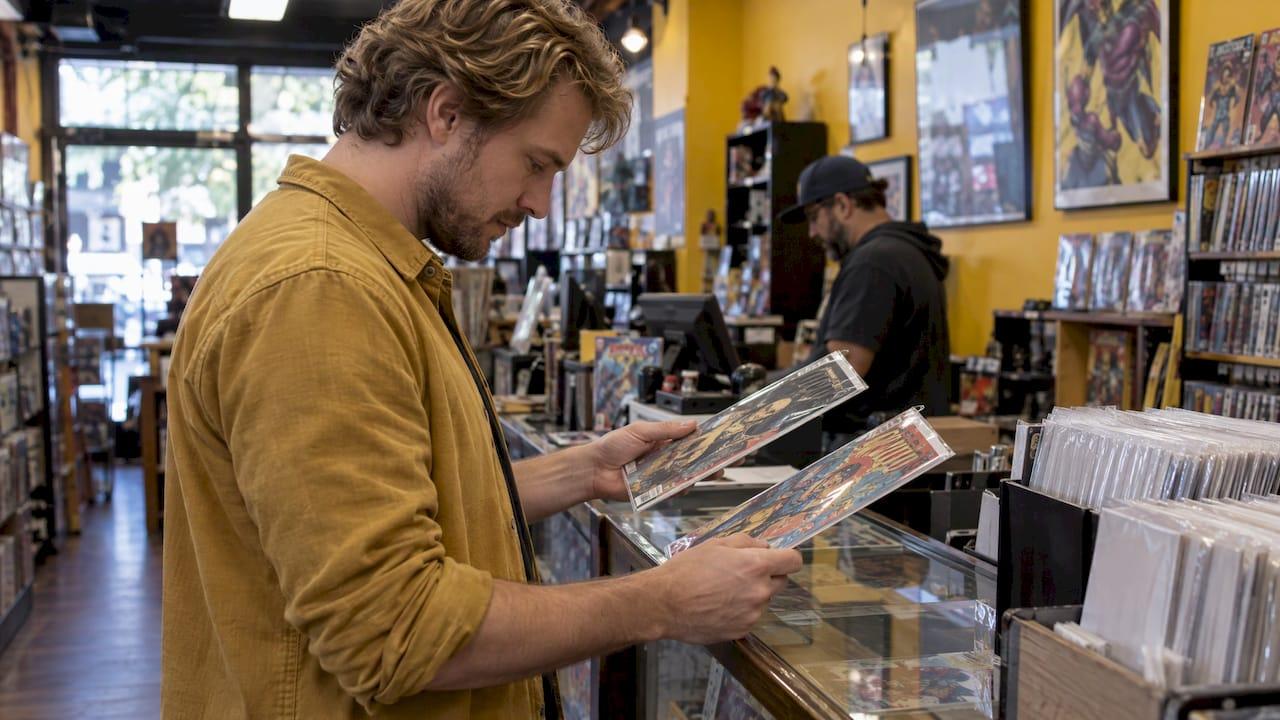
The best place to buy comic book back issues is a local shop with a deep bin section, backed up by conventions and a short list of sold prices you check before you pay. You get to hold the book, judge its condition yourself and pay a fair price. Fanboys is built for exactly that first step: finding the shops, events and local sellers near you, searchable by fandom and location.
This guide covers what a back issue is, where to look, how to read condition, how to price a book and how to get better deals from the shops you find.
TL;DR
- A back issue is any comic that is no longer the current issue on the new-release shelf, whether it came out last month or in 1975.
- Start local: shops with back-issue bins, conventions and local seller listings let you inspect each copy before you pay.
- Judge condition on the 0.5 to 10.0 grading scale: spine, corners, staples, page color and cover gloss.
- Price from completed sales of the same issue and grade, never from asking prices.
- Build a want list, ask about sales and pull lists, and the same shop will keep finding books for you.
Table of Contents
- What a back issue is (and why the term matters)
- Where to buy used comic books
- How to work a shop's back-issue bins
- How to check the condition of an older comic
- How to price a back issue
- Our view: the best back-issue hunters are local
- Find back-issue shops near you with Fanboys
- FAQ
- Sources
What a back issue is (and why the term matters)
A back issue is a comic that has been replaced on the new-release rack by a later issue. Some shops treat anything a month old as a back issue. Others use the word for older books only. In practice it covers everything from last month's issue #3 to a 1960s key book in a plastic sleeve.
Shops usually file back issues in long boxes, sorted by publisher, then title, then issue number. Because every copy is a separate collectible, two copies of the same issue can carry very different prices. A reader copy with a creased spine and a sharp copy of the same book are not the same product.
This is why the market rewards people who know what they are looking at. Writer David Harper, in a 2020 SKTCHD report, described the back-issue market as booming across every era, from Bronze Age to Modern Age, in shops, at auction houses and online. Demand is real, and the way to buy well is to know your issue, your condition and your price before you walk up to the register.

Where to buy used comic books
You have four main routes. They work best in combination.
Local comic shops
A shop with a real back-issue section is the best place to learn. You can flip through boxes, pull a book out of its bag and compare it with the copy next to it. Prices are usually marked on the bag or the board, and many owners will talk through a price if you buy several books.
The hard part is knowing which shops near you actually stock back issues. Some focus on new releases and keep only a small bin. Others are mostly back stock. On Fanboys you can browse shops by city, for example comic stores in Los Angeles, Denver, Portland, Philadelphia or Seattle. Listings are added by the community, so the people who actually shop there help keep the picture accurate. Our longer guide to used comic book stores near you explains how to compare shops before you visit.
If you are in a big metro area, the city guides for New York City, Chicago, San Diego, San Francisco and Washington, DC are good places to build a route of several shops in one afternoon.
Conventions and comic shows
Shows put dozens of dealers' back-issue stock under one roof. A regional comic book show can offer tens of thousands of back issues, and some include a grading facilitator on site. The Pittsburgh Comic Book Show is a good example of the format: around 100 tables of purely comics, rare and key issues, slabs and guest artists, with free admission for certain groups. Dates change every season, so check the organizer's page for the current schedule.
Shows are where you compare the same issue across many dealers in minutes. Our guide to comic book shows near you shows how to find the right one for your area and budget.
Online sellers
Online shops and auction sites carry the widest range, which helps when you need one specific issue to finish a run. The trade-off is that you buy from photos. Treat every online listing as an asking price and apply the checks below before you buy: clear photos of front, back and spine, a stated grade, and a return policy.
CGC, the grading company, points collectors to its dealer locator, online retailers, auction sites and conventions as ways to find books, which matches how most experienced collectors split their buying.
Local sellers and collectors
Private collectors often sell good books at fair prices, because they are not paying retail overhead. A location-based marketplace lets you find these sellers near you, meet in person and inspect the book before you hand over money. Fanboys includes a marketplace for local merchandise, so you can check what nearby collectors have listed alongside the shops and events in your area.
How to work a shop's back-issue bins
Walking into a shop and flipping aimlessly gets you tired, not books. A little structure gets you much further.
- Write a want list before you go. Keep it on your phone: title, issue number, and the printing or cover you want. A list stops you from buying a book that looks like a deal but is not on your path.
- Stay with series you know. Collector guidance from GoCollect recommends sticking to runs you understand, such as the first 300 issues of Amazing Spider-Man, so you recognize a good price when you see one.
- Ask what is behind the counter. Silver Age key books are often kept behind the counter or on the wall rather than in the bins. The same guide says these are commonly marked 10 to 20 percent off, and that you should ask to take the book out of its bag to check it is complete. Missing pages and pieces are the main source of buyer losses.
- Ask about sales. Holiday and special-event sales often discount back issues by 30 to 50 percent, according to that same source. At 30 percent off, the savings can cover sales tax and still leave room for resale profit if you ever sell.
- Bundle. Shops are usually more flexible when you bring ten books to the counter than when you ask for a discount on one.
- Set up a pull list. A pull list is a list of current titles the shop holds for you each week. CGC notes it builds a relationship with your shop, and some shops keep a card on file and charge when your books are pulled. A shop that knows you will often mention a back issue that just came in.
A few more in-store habits are worth borrowing from other hobbies too. These expert collecting tips are written for stamps, but the habit of hunting methodically, keeping notes and knowing what you want applies just as well in a comic bin.
How to check the condition of an older comic
Condition is the biggest driver of value. The same issue can sell for a small amount in rough shape and many times more in high grade. Comics are graded on a scale from 0.5 (Poor) to 10.0 (Gem Mint), a system based on the standard laid out in the Overstreet guide to grading, which the Library of Congress lists among its recommended references. Look at these areas in order:
- Cover and spine. Look for stress lines, which are small creases along the spine. Lines that break the cover ink matter more than ones that do not. Tilt the cover under a light to reveal creases that are hard to see head-on.
- Corners and edges. Rounded or blunted corners, chips and tears all lower the grade.
- Staples. Rust, loose staples or popped staples point to wear or past handling.
- Pages. Page color runs from white to cream to brown. Brown, brittle pages are a sign of age and poor storage.
- Cover gloss, fading and stains. Look for writing, tape, water marks and sun fading.
- Completeness. Make sure no pages, coupons or inserts are missing. Missing pieces cannot be fixed by cleaning or pressing.
- Restoration. Color touch-ups, trimmed edges, cleaned pages and added glue count as restoration and lower value. A book that looks unusually sharp but slightly small may have been trimmed.
Some extra checks for older books: look at the indicia, the small print block with publication details, for printing information and reprint markings, so you know you are holding the printing you are paying for. Also notice whether the copy is a newsstand or direct edition, because the two can price differently on the same issue.
Do not clean, press or repair a comic before you have it assessed. Altering a book can complicate an appraisal and lower its value.
Raw versus graded
A raw comic is unslabbed. You judge it yourself, and the price should reflect your read of its condition. A graded comic has been sealed in a holder with a number grade from a third-party service. Graded books cost more, but the grade is set, and you can verify a slab by its certification number on the grader's website. Spanish-language collectors have a similar vocabulary in other hobbies, such as these condition grades used for collectible banknotes, which shows how a short grade label can move a collectible's price.
For buyers, the practical rule is simple. If you are paying for a high grade, buy the slab or inspect the book in person. If you are buying a lower-grade reader copy to enjoy, raw books in a shop bin are usually the better value.

How to price a back issue
The price on the bag is the shop's opinion. A price you can trust comes from what buyers have actually paid.
- Identify the exact book. Title, issue number, year, printing and cover. Variants and reprints can sit at very different prices.
- Check completed sales. CGC advises buyers who are unsure to look up value on a price-guide site and to search eBay sales history to see what others are paying. Look at sold results, not live asking prices.
- Match the grade. A sale of a 9.0 copy tells you little about a 5.0 copy. Compare like with like.
- Look at the range. Note the lowest and highest sold prices for that issue, then use condition to explain the spread. Where there are several sales, the middle value is a steadier guide than the highest.
- Use a price guide for context. Price guides are published monthly, quarterly or yearly and track changes in resale value; they are also used for estimating insurance worth. They are a starting point, and recent sales are the better test of today's market.
A quick example: you find a mid-grade copy of a 1970s issue marked at a price that feels high. You look up three recent sold copies in the same grade band and find they cluster slightly below the tag. Now you have a reasoned offer, and most shop owners respond well to a polite, informed question such as whether there is flexibility on the price, especially when you are buying more than one book.
Also remember that a lower original cover price generally points to an older book, but age alone does not decide value. Key first appearances and popular characters matter more than the date on the cover.
Our view: the best back-issue hunters are local
We built Fanboys because the best part of collecting is not the checkout page. It is the afternoon you spend in a shop you did not know existed, flipping through a bin and talking to someone who knows exactly where that missing issue went.
Back issues are a hands-on category. Condition, completeness and printing all show up better in your own hands than in a product photo. That is why we focus on local: shops, shows and neighbors who sell what you collect, all in one place and searchable by fandom and by location.
We also believe the community should shape the map. On Fanboys, people add stores and events themselves, so the listings reflect the places fans actually go. If you know a shop with a great dollar bin, add it. If you have a stack of duplicates, list them for local buyers. A directory that fans build together stays useful to fans.
Start with your own city, build a want list and keep going back to the same two or three shops. The books will find you.
Misty
Find back-issue shops near you with Fanboys
Fanboys is a free place for fans to discover local comic shops, collectible stores, conventions and community events, with search by fandom and location, local deals and a marketplace for merchandise. Pick your city, compare the shops near you and plan a route. Collectors in Denver, Philadelphia and Los Angeles can also browse collectible stores alongside comic shops, and you can watch shop tours on our comic shop and collector reels page.

Start at fanboys.site, choose your city and see which shops and events are closest to you.
FAQ
What is the difference between a back issue and a new release?
A new release is the current issue on the shelf. Once a newer issue replaces it, it becomes a back issue. Some shops draw that line at a month old, others only call older books back issues. The term covers everything from last month's comic to decades-old keys.
Where is the best place to buy used comics?
For most buyers, a local shop with a deep back-issue section is the best start, because you can inspect each copy and ask questions. Conventions add dealer variety in one place, and local seller listings can turn up good books near you. Fanboys lists shops, events and local sellers by city so you can see your nearest options at once.
How do I know if a used comic is worth the price?
Identify the exact issue, printing and grade, then compare it with completed sales of the same book in the same condition. Asking prices are only what sellers hope to get. If the tag is above recent sold prices, ask politely whether the shop can come down, especially if you are buying several books.
Should I clean or press an old comic before selling or grading?
No, not before it has been assessed. Altering a comic can complicate an appraisal and lower its value, and pressing cannot restore missing pieces or heavy damage. If you are thinking about grading, have the book looked at first by someone who handles graded books.
Are back issues a good investment?
The market has been strong. The SKTCHD report describes growth across all eras since the pandemic. Prices move with demand, condition and key status, and no book is guaranteed to rise. Buy what you enjoy, at a price supported by recent sales, and treat resale value as a bonus.
Sources
- How to Get Started Collecting Comic Books, CGC Grading
- Comics' Hottest Game is...Back Issues?, SKTCHD
- Comic Book Pricing and Appraisal, Library of Congress research guide
- Comic book price guide, Wikipedia
- Pittsburgh Comic Book Show
- Comic Collecting 101: The Brick and Mortar Treasure Hunt, GoCollect blog