
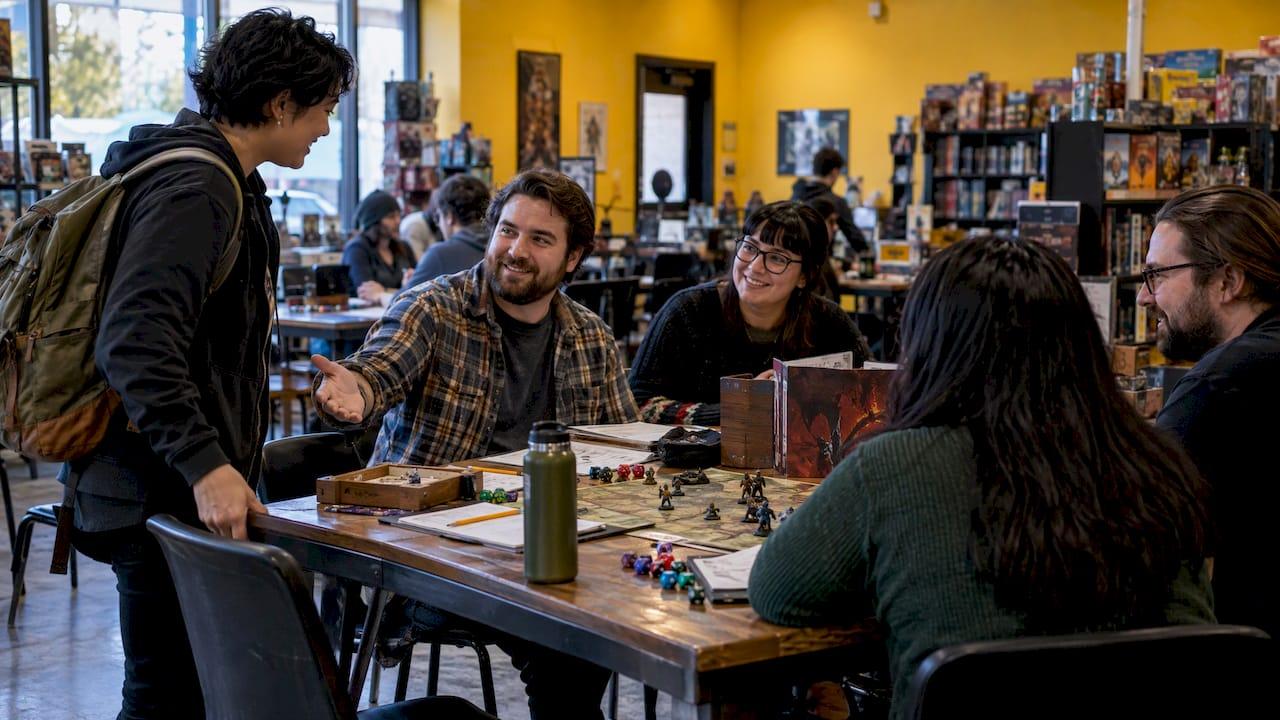
The fastest way to find a D&D group near you is to start at a local game store. Stores host open tables, organized-play nights and beginner one-shots where you can sit down with strangers without committing to anything. Then widen the search to official finder tools, community boards and online play if your area is thin. On Fanboys you can search local game stores and fan events by city, and the community adds the listings, so the shop that runs a Thursday night table is often the one a neighbor already posted.
This guide covers where groups actually meet, how to tell a welcoming table from a shaky one, what to ask before you show up, and what your first night looks like.
TL;DR
- Local game stores are the easiest entry point: many host open tables and Adventurers League nights where you can drop in and meet a group.
- Wizards of the Coast now runs an official D&D Event Finder in D&D Beyond that shows games at local stores, plus a Find a Game channel on its Discord server.
- Look for phrases like "new players welcome," "learn to play" and "one-shot" in a listing. They signal the organizer expects to teach.
- Ask about session length, tone, safety tools and scheduling before you commit, and try one session first.
- If nothing fits nearby, an online table is a real option, and you can mix both.
Table of Contents
- Start with the game store down the street
- Use the official D&D Event Finder
- Other places local groups hide
- How to spot a table that welcomes new players
- In person or online?
- What to check before you join
- What your first session looks like
- A short plan for the first month
- Find your local shops on Fanboys
- FAQ
- Sources
Start with the game store down the street
A game store is a public place with staff, a table and a schedule. That makes it the lowest-risk way to meet a group. You can walk in, ask who runs games, and read the events board before you spend a minute playing.
The official organized-play program is built for this. Adventurers League is the official organized play system of D&D, and it lets a character travel from one table to another, keeping progress and loot. You can play it at conventions, a local game store or at home. In practice that means a character you build for one store's Wednesday night works at a different store across town.
What store nights tend to look like:
- Drop-in tables. You show up, the organizer seats you, and you play a single adventure. In Spokane, for example, Inlander's beginner roundup described one store running open Sunday one-shots, another with Thursday evening drop-ins where newcomers played free, and a third with three-hour beginner one-shots a few times a month. Prices and schedules change, so treat those as examples of the pattern, not a current listing.
- Pre-made characters. Beginner tables usually hand you a ready character so you can play in minutes.
- Small fees or none. Many stores charge a few dollars per seat or nothing, in the hope you will eventually buy dice or books there.
To find stores near you, browse a city directory instead of guessing. Fanboys has local pages for game stores in cities such as Portland, Seattle, Phoenix, Mesa, Eugene, Dallas and Washington, DC. Comic shops often host games too, so check the comic store pages for cities like Boston or San Diego as well.
If your table also uses miniatures or you want terrain and paints, our guide to miniature gaming stores explains how to find shops with room to play.
Use the official D&D Event Finder
In August 2026, D&D Beyond launched three new ways to reach a table: a D&D Event Finder where local game stores post events, a rebuilt official Discord server with a dedicated Find a Game section, and a StartPlaying partnership that lets new players book a professional DM for $0.99 for a limited time.
The Event Finder is the one to try first if you want in-person play. It surfaces sessions at stores in the Wizards Play Network, which is the program of stores that run games and sell official D&D products. It pairs well with a store visit: find the listing, then walk in a few minutes early and say hello to the person running it.
A search tip that applies to every tool: say what you want. Playstyle (combat-heavy or story-heavy), the nights you are free, and whether you can travel or need to play online will filter out most mismatches before you ever message anyone.

Other places local groups hide
Not every table is posted at a store. Several other channels turn up groups:
- Community boards and social groups. Nerdist's guide suggests searching for terms like "dungeons & dragons" plus your city on social platforms, and checking the usual looking-for-group communities and event-listing sites.
- Conventions and open-seat events. Big conventions run open-seat games all weekend. If one is within driving distance, it is a good way to try several DMs in a short time. Our comic book shows guide shows how to find shows near you, and many have gaming rooms.
- Friends and coworkers. A surprising number of tables start with someone saying they are looking for a fifth player. Ask around.
- Neighboring hobby clubs. People who play chess, miniatures or card games often play D&D as well. Our guides to chess clubs and shops and anime clubs show how to find the spots where those crowds gather.
A good habit: pick two channels, one store-based and one online, and check both weekly for a month. Most people who give up looked in one place for one weekend.
How to spot a table that welcomes new players
Listings are written for the organizer's ideal player. Read them for signals.
Phrases that mean the group expects to teach:
- "New players welcome"
- "Learn to play"
- "Beginner one-shot"
- "Session zero" (a first meeting where the group agrees on tone, rules and boundaries)
- "Adventurers League"
- "Drop-in friendly"
- "No experience needed"
Phrases that suggest a closed or experienced-only table: "must know 5e well," "long-running campaign, one seat," or a long list of required house rules and books.
One-shots (a single self-contained adventure, usually three or four hours) are the gentlest start. You find out if you like the game, the people and the commute without joining a campaign that runs for months.
In person or online?
This is the first choice that shapes everything else. In-person play gives you body language, snacks and real dice, but your options are limited to what you can drive to. Online play opens up tables across the country, but it needs steady internet and a virtual tabletop, which is the software that shows the map, dice and character sheets on your screen.

A rough rule: if you live in or near a city with several game stores, start in person. If your nearest store is an hour away, or your schedule is tight, an online table may be the realistic option, and you can add a local group later. If you want to see what a browser-based tabletop feels like with sheets and dice built in, a homebrew virtual tabletop shows how monster stat blocks and characters are handled on screen.
Many players end up with both: a Wednesday store night and a Sunday online campaign with friends who moved away.
What to check before you join
A bad table is rarely dangerous, but it can be a waste of your evenings. A few questions up front prevent most problems. Nerdist's advice is to ask the DM about time commitment, play style and how much role-play is expected before you sign on.
Bring these questions:
- Is the table beginner-friendly?
- What is the tone: lighthearted, serious, horror?
- How long are sessions, and how often do they meet?
- Is there a session zero?
- Does the DM use safety tools such as lines and veils or the X-Card, which let players set limits on content or pause a scene?
- Is it combat-heavy or role-play-heavy?
- Is there any cost, and what does it cover?
The session zero and safety-tool questions matter most if the game leans into dark themes. Tabletop Time notes that the X-Card and Lines and Veils are small asks for a DM, and that a table with heavy content whose DM has never heard of them is worth pausing on.
If you are playing at a store, you will usually meet the people in a public space first. If you are meeting a private group, pick a public spot for the first session, tell a friend where you will be, and do not pay anyone in advance before you have met the table.
Red flags worth noticing
- No session zero and no clear expectations about tone or scheduling
- A DM who wants money before you have sat at the table
- Favoritism, or a group that treats new players as a nuisance
- A long, unexplained list of banned options
One of these is a conversation. Two or three together is a reason to try another table.
What your first session looks like
At a beginner-friendly table you usually choose from pre-made characters, the GM explains what your character can do as it comes up, and rules are taught one moment at a time. Asking questions is part of the game, so ask.
A few practical notes:
- Arrive ten minutes early to meet the organizer.
- Bring a pencil and a notebook. Bring your own dice if you have them, but most tables lend a set.
- Say what you want from the evening: fighting, talking, exploring. Good DMs adjust.
- Afterward, thank the organizer and say whether you want to come back. Interest is not obvious to other people, and many potential friendships stall because nobody says it.
Most of the game is learnable in a session or two, and a short arc of three to five sessions is a lower-risk first commitment than a campaign with no end date.
A short plan for the first month
| Week | What to do |
|---|---|
| 1 | Search your city's game stores and note which ones post D&D nights. Check the D&D Event Finder for the same stores. |
| 2 | Visit one store on its open night. Watch, ask who runs the table, and play a one-shot if there is a seat. |
| 3 | Try a second venue or an online table so you can compare DMs and tone. |
| 4 | Pick the table you looked forward to most, ask about the next session, and say you want a seat. |
Our take on finding your table
People rarely fail to find a D&D group because there are none. They fail because the information is scattered across store counters, event pages and chat servers, and nobody tells them which one is a good first stop.
That is why we think local discovery should be community-built. The person who knows that a comic shop clears its back tables on Thursdays is a neighbor, not a national database. On Fanboys, anyone can add a store or an event, so listings reflect what people in your area actually use, and you can search by fandom and location.
Our advice: start with a place you can walk into, go once, and keep what works. A store, a shared table and a bag of dice will teach you more than a week of scrolling.
Misty
Find your local shops on Fanboys
Fanboys is a local discovery platform for fans: comic shops, collectible stores, game stores, conventions and community events, with city guides and listings that users add themselves. If you are looking for a D&D table, the quickest route is to see which game stores and comic shops are near you, then check what they run.

Browse the Fanboys homepage to search by city and interest, or go straight to a city page such as game stores in Seattle. If you know a shop that hosts a game night, add it so the next player finds it faster.
FAQ
Where can I find D&D groups near me?
Start with local game stores and comic shops, which often host open tables and organized-play nights. Then check the official D&D Event Finder in D&D Beyond, which lists games at local stores, and the Find a Game section of the official D&D Discord server. Community boards and conventions add more options.
Do I need experience to join a D&D group?
No. Many store nights and one-shots are designed for first-timers, and the organizer usually provides pre-made characters and explains the rules as they come up. Look for listings that say "new players welcome" or "learn to play."
Is it free to play D&D at a game store?
Often it is free or costs a few dollars. Fees vary by store and by night, so check the listing or ask the store. Some beginner one-shots charge a small fee for the longer session, and some drop-in nights are free for newcomers.
How do I know if a group is a good fit?
Ask about tone, session length, scheduling and safety tools before you join, then try a single session. A table with a session zero, clear expectations and a welcoming DM is a good sign. If you feel uncomfortable or pressured, you can leave and try another table.
Should I play in person or online?
In person gives you the full social experience, and online gives you a bigger pool of tables. If you have several stores nearby, start there. If you live far from a store or your schedule is tight, online play is a practical alternative, and many players do both.
Sources
- D&D Beyond group-finding features, Vice
- What Is Adventurers League?, Wizards of the Coast
- Beginner D&D spots in Spokane, Inlander
- How to Find a Dungeons & Dragons Group, Nerdist
- How to Find a D&D Group Without Losing Your Mind, Tabletop Time
- Your First D&D Session: What to Expect, The One Shot Tavern